


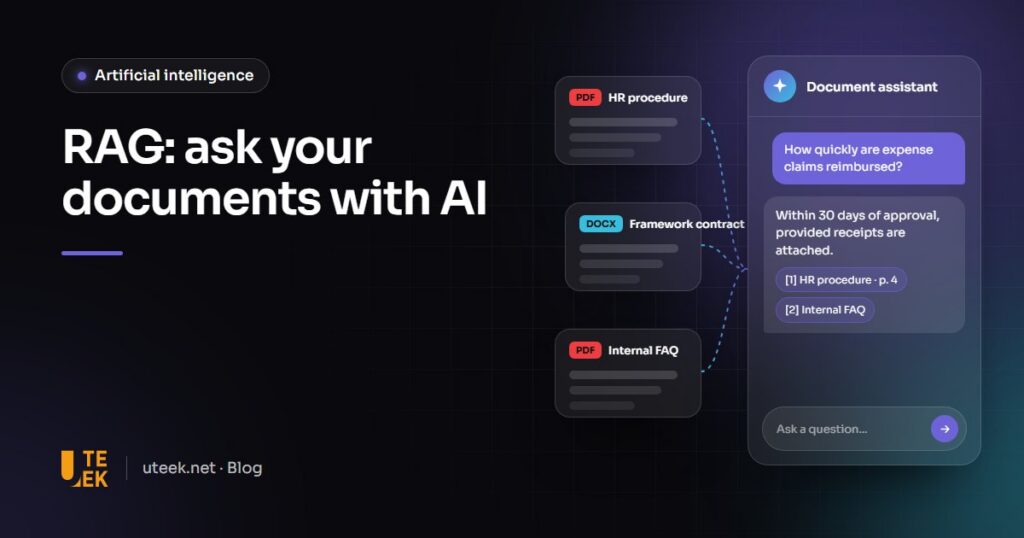
RAG for business (retrieval-augmented generation) lets you search your internal documents in plain language: an AI assistant finds the relevant passages in your procedures, contracts or manuals, then writes an answer that cites its sources. It answers from your texts rather than from memory, which limits made-up answers and means no retraining when a document changes. Well designed, it respects each user’s access rights and admits when it does not know.
Key takeaways
- RAG combines a search through your documents with a language model that writes a sourced answer.
- It suits procedures, HR policies, technical documentation, contracts and knowledge bases.
- Reliability depends on citations, test questions and up-to-date documents.
- Security means respecting access rights, choosing the right hosting and preventing prompt injection.
What is RAG in artificial intelligence?
The term comes from a research paper by Patrick Lewis and his co-authors, presented at NeurIPS 2020. The principle: complement a language model’s built-in memory with an external source consulted for each question, at the time an index of Wikipedia passages.
In a business, that source is your documents, so updating the assistant simply means updating the documents.
How does RAG work, step by step?
- Collect and convert: documents (file server, document management system, cloud storage, intranet) are converted to text, with optical character recognition (OCR) for scans.
- Split into passages: each document is divided into extracts of a few paragraphs that keep their title and source.
- Create embeddings and a vector index: each passage becomes a vector, a series of numbers representing its meaning, stored in an index.
- Retrieve the relevant passages: the index returns the passages closest in meaning to the question, even when worded differently.
- Generate a sourced answer: the model receives the question and those passages, then writes an answer that cites its sources.
Which internal documents can you query?
- Procedures and HR policies: ‘How many days of leave after two years?’ gets an answer and a link to the relevant policy.
- Quality and technical documentation: operating procedures, data sheets, maintenance manuals.
- Contracts and tenders: find a clause, compare terms, check the requirements of a specification.
- Support knowledge base: agents find the right procedure without browsing dozens of pages.
- Onboarding: instant answers for new starters.
RAG, search engine, chatbot or fine-tuning: what is the difference?
| Approach | What it does | Data freshness | Sources cited | Cost and effort |
|---|---|---|---|---|
| Classic search engine | Lists documents containing your keywords | Current once indexed | Yes, the documents themselves | Low, often already in place |
| Generic chatbot | Answers from its general knowledge | Frozen at training, unless it searches the web | Variable, not your internal documents | Low, but no access to your documents |
| RAG | Writes an answer from passages retrieved in your documents | Current once re-indexed | Yes, passage by passage | Moderate: preparation, integration, testing |
| Fine-tuning | Adjusts the model on your examples | Frozen at training | No | High, repeated to add new information |
RAG and fine-tuning can be combined: RAG for information that changes, fine-tuning for style.
How do you make the answers reliable?
- Cite sources: every answer links to the passages used.
- Say ‘I don’t know’: the assistant answers only from the retrieved passages and says so when they fall short.
- Evaluate with test questions: around fifty real questions with expected answers, written by subject-matter experts and rerun after every change.
- Keep documents up to date: an owner for each document, outdated versions removed, automatic re-indexing.
How do you protect confidential data?
Respect existing access rights
The assistant must only retrieve documents the user can already see, with permissions applied during retrieval, before the model sees anything. Otherwise, an innocent question could surface a salary grid.
Choose your hosting
- Cloud provider with contractual guarantees: no training on your data, retention and data location set out in the contract.
- Hosting in the European Union or on premises: for sensitive data.
- Open-source models: run in-house with no external transfer, but with servers to manage.
Prevent prompt injection
A document can hide instructions: OWASP describes a CV whose white-on-white text tells the system to recommend the candidate. Its Top 10 for LLM applications ranks prompt injection first and has a dedicated entry on vector and embedding weaknesses. Index trusted sources only and keep the assistant read-only.
Manage logs
Questions may contain personal data: restrict access to logs and their retention, in line with Tunisian data protection law and, where it applies, the GDPR.
How do you launch a pilot project?
- Choose one use case and one corpus: a frequent question, a bounded set of documents, a pilot team.
- Clean the documents: duplicates, outdated versions, illegible scans.
- Build the assistant: connectors, index, access rights, interface.
- Test with real users and the test questions.
- Measure: correct answers, correct sources, unanswered questions, time saved.
- Extend to other documents or teams if the results hold up.
What drives the cost of a RAG project?
The main drivers are document volume and condition, the number of sources to connect, access rights complexity, a pay-per-use API or dedicated servers, question volume and ongoing upkeep. A pilot helps you estimate them before scaling up.
FAQ
Does RAG stop AI from making up answers?
It reduces the risk without eliminating it, as the model can still misread a passage. Citations let users check every answer, and test questions measure the actual error rate.
Do you need to retrain the model when a document changes?
No. You only need to re-index the updated document, which can be automated. This is one of RAG’s main advantages over fine-tuning.
Which document formats can be queried?
PDFs, Word documents, spreadsheets, presentations and intranet pages work well. Scans go through OCR, whose quality must be checked.
Are our confidential documents sent to a third party?
It depends on the architecture. With an API-based model, some or all of your document content goes to the provider, so insist on contractual guarantees. For the most sensitive documents, an open-source model on your own servers avoids any external transfer.
Search your documents with Uteek
At Uteek, a digital agency based in Les Berges du Lac 2, Tunis, our AI team designs and integrates RAG assistants connected to your documents and tools, from choosing the corpus to hosting. Explore our artificial intelligence services or tell us about your project.
Related articles
AI chatbot for your website: how it works, integration and limits
A well-designed AI chatbot answers 24/7 from your own content and hands over to a human when needed.…
AI for business: 7 practical use cases for SMEs
Customer assistants, automated invoice reading, sales forecasting… AI is no longer just for large corporations. 7 practical use…
AI agents for business: what they are, practical use cases and how to deploy them safely
Sorting emails, qualifying leads, drafting quotes… AI agents no longer just answer questions, they take action. Use cases,…