


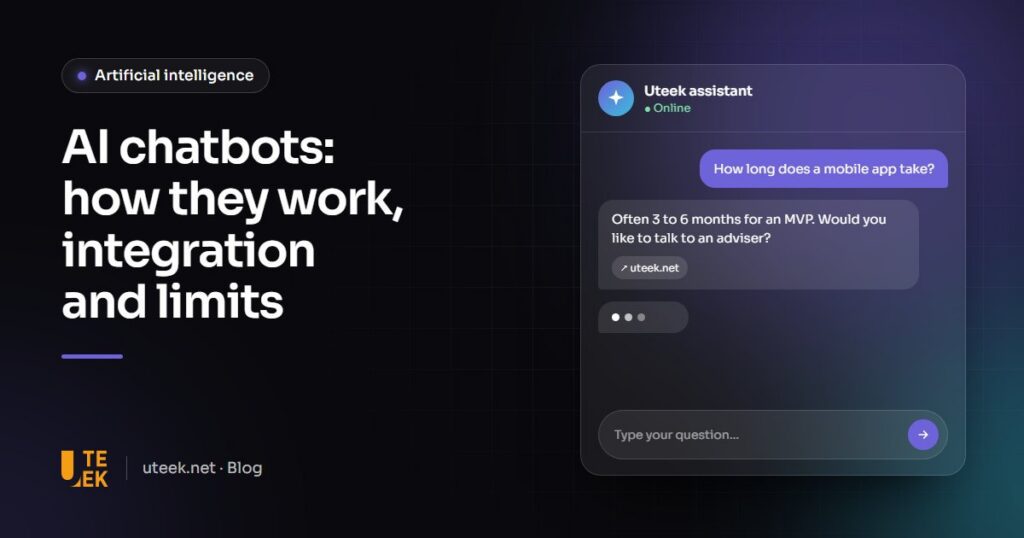
An AI chatbot for your website is a conversational assistant that understands visitors’ questions in their own words and answers them from your own content: services, public pricing, procedures and FAQs. Unlike older decision-tree chatbots, it doesn’t force users to click through predefined options. When well designed, it answers 24/7 in several languages and passes the requests it shouldn’t handle alone to a human agent.
Key takeaways
- A modern AI chatbot combines a large language model with your knowledge base (the RAG approach).
- It integrates with your website, WhatsApp or Messenger, and can create leads in your CRM.
- It must be restricted to your content, cite its sources and hand over to a human when necessary.
- You manage it with clear metrics: resolution rate, handover rate, satisfaction.
How does an AI chatbot work?
Most business assistants rely on RAG (Retrieval-Augmented Generation):
- Your content (web pages, documents, FAQs) is split into passages and indexed in a search database.
- When a visitor asks a question, the system retrieves the most relevant passages.
- The language model writes an answer based only on those passages, in the visitor’s language.
- The answer can show its sources and suggest an action: book a meeting, request a quote, talk to an agent.
This approach limits made-up answers and lets you update the chatbot’s knowledge without retraining it: you simply update the content.
Rule-based chatbot or AI chatbot?
| Criterion | Rule-based chatbot | AI chatbot |
|---|---|---|
| Understanding | Keywords and buttons | Natural language, free-form questions |
| Languages | One version per language | Multilingual from the start |
| Updates | Edit every scenario | Update the source content |
| Unexpected questions | Poorly handled | Well handled within the defined scope |
| Control over answers | Total | Must be framed with rules and testing |
Where should you deploy it?
- On your website: a chat window on key pages (services, pricing, contact).
- On WhatsApp Business and Messenger: where your customers already write, which is especially relevant in North Africa and the Middle East.
- Inside your tools: automatic creation of a CRM lead, a support ticket or a calendar booking.
- Internally: an assistant for your staff, connected to company procedures and documents.
Limits to plan for
- Errors: even when well framed, a model can get things wrong. Restrict it to your content, forbid off-topic answers and test it against hundreds of real questions.
- Sensitive topics: negotiated prices, complaints, legal or medical questions should go to a human.
- Languages and dialects: English, French and Modern Standard Arabic are well understood; local dialects are handled less consistently and must be tested.
- Personal data: inform users, limit the data collected and comply with applicable regulations, such as the GDPR for European visitors.
- Usage costs: every answer consumes model calls; the budget depends on conversation volume and should be monitored.
6 steps to an AI chatbot project
- Define the scope: questions handled, questions handed over, languages, channels.
- Gather the content: FAQs, service pages, terms and procedures, up to date and consistent.
- Design the conversation: tone, welcome message, handover to a human, contact capture.
- Build and integrate: website, WhatsApp, CRM, monitoring dashboard.
- Test: a set of real questions, edge cases and misuse attempts.
- Manage: review conversations every month, enrich the content, adjust the rules.
Metrics to track
| Metric | What it measures |
|---|---|
| Resolution rate | Share of conversations handled without human help |
| Handover rate | Share of conversations passed to an agent |
| Satisfaction | Rating given by the user at the end of the chat |
| Conversions | Quote requests, bookings or sales generated by the chatbot |
| Unanswered questions | Topics to add to the knowledge base |
FAQ
Can an AI chatbot replace customer service?
No, it complements it. It absorbs repetitive questions and answers outside business hours, freeing agents for high-value requests.
How long does it take to launch an AI chatbot?
A first assistant with a clearly defined scope can go live within a few weeks, provided the source content is ready. CRM or WhatsApp integrations take longer.
Can the chatbot answer in Arabic and French?
Yes. An AI chatbot detects the language of the question and replies in that language, even if the knowledge base is written mainly in English. Answers must still be tested in each language.
How do you stop the chatbot from making things up?
By restricting it to the content you provide, instructing it to say when it doesn’t know, making it cite its sources and regularly testing its answers on real questions.
Your AI chatbot with Uteek
Uteek designs AI assistants and chatbots connected to your content and tools: website, WhatsApp and CRM. We start by defining the scope and success metrics. Tell us about your project.
Related articles
AI for business: 7 practical use cases for SMEs
Customer assistants, automated invoice reading, sales forecasting… AI is no longer just for large corporations. 7 practical use…
Launching an e-commerce website in Tunisia: platform, online payments, delivery and compliance
Cash on delivery or online payment, logistics, legal requirements, platform choice: everything to plan when launching an e-commerce…
Website redesign: the SEO checklist to keep your traffic
A poorly prepared redesign can wipe out years of search visibility. Inventory, 301 redirects, testing and monitoring: the…