


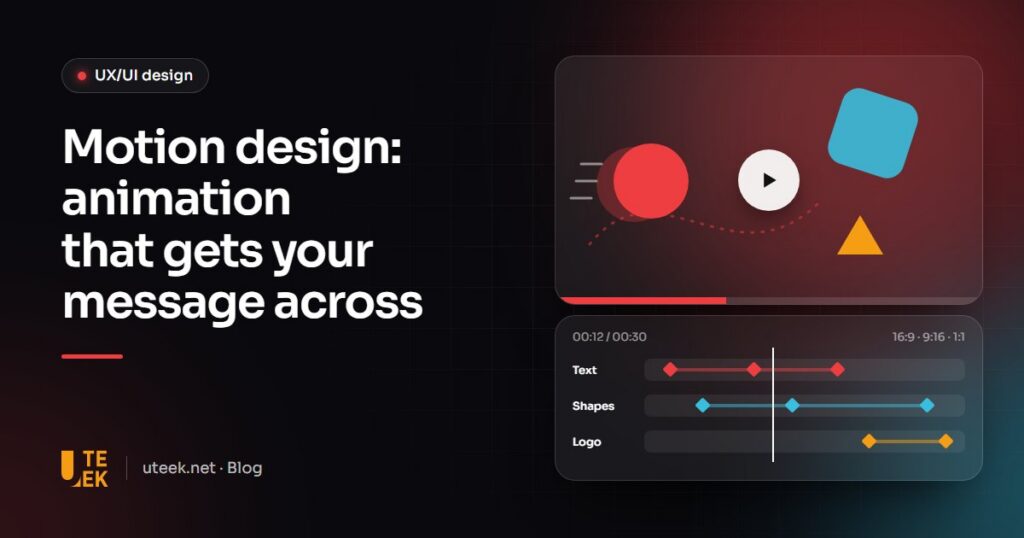
Motion design means animating graphic elements (typography, shapes, illustrations, icons, data) to get a message across in a few seconds or a few minutes. For a business, it is an effective way to explain a complex offer, stay true to its visual identity and adapt the same content into several languages and formats, without a film shoot. Success depends first on the script: the animation serves the message, not the other way round.
Key takeaways
- Motion design animates graphics; it is easier to update and translate than filmed video.
- It is particularly suited to intangible offers and social media.
- Production follows clear steps, from the brief to versions in several formats.
- Accessibility is planned from the start: captions, no rapid flashing, reduced motion respected.
What is motion design?
Short for “motion graphic design”, motion design brings graphic design to life: text that appears, a logo that builds itself, a chart that draws itself. Everything starts from the brand’s visual guidelines, and it can be combined with animated characters or filmed footage.
Motion design, filmed video or 3D animation?
| Criterion | Motion design | Filmed video | 3D animation |
|---|---|---|---|
| Raw material | Typography, shapes, illustrations, data | Real people, places and products | Modelled objects and sets |
| Best for | Explaining an offer, a process, figures | Testimonials, behind the scenes, emotion | Showing a product from every angle |
| Updates | Simple: edit a scene | Often a new shoot | Possible, but heavier |
| Translation | Text and voice-over easily replaced | Subtitles or dubbing | Easy if text is kept separate |
| Watch out for | Script and art direction | Shoot logistics | Modelling and rendering time |
Why does motion design work for businesses?
It makes the abstract concrete
A financial service or a software platform is hard to film. Animated diagrams and visual metaphors show how things work step by step.
It extends your visual identity
Colours, typefaces, pictograms: every frame follows your brand guidelines, consistent with your other materials.
It is easy to update and translate
A price changes, a new market opens: you only need to edit the scenes concerned. French, English or Arabic versions start from the same files, adapting the text, the voice-over and, for Arabic, the reading direction.
It works without sound
On several social networks, videos start muted in the feed: on-screen text and captions then carry the message.
It adapts to many formats
The same animation can be delivered in 16:9 for a website or YouTube, 9:16 for stories, 1:1 for feeds, or as short clips.
Which formats for which uses?
- Explainer video: presenting an offer, a service or a process.
- Social media: posts and stories, announcements, key figures.
- Logo animation: end-of-video signature, app launch screen.
- Product or app demo: a clean user journey, without the clutter of raw screen recordings.
- Onboarding and tutorials: welcoming new users, explaining a procedure.
- Events and screens: trade fairs, reception screens, conferences.
- Animated data and infographics: annual report, survey results.
- UI micro-interactions: buttons, transitions, loading indicators, often in the lightweight, cross-platform Lottie format.
The production steps of a motion design video
- Brief: target audience, key message, expected action, channels and languages.
- Script: voice-over and on-screen text. Read it aloud with a stopwatch: it sets the length.
- Storyboard: one frame per scene to approve the sequence.
- Style frames: a few finished images that set the art direction.
- Voice-over and music: choice of voice, recording, licensed music.
- Animation: bringing the scenes to life, synchronised with the voice.
- Sound design: sound effects that give the animation its rhythm.
- Versions: 16:9, 9:16 and 1:1 formats, language versions, captions.
Approve the script, storyboard and style frames before animating: a sentence is easy to change in a script, much less so in an animated scene.
How long should it be?
The right length is the shortest one that delivers the message. A few seconds are enough for a logo animation. On social media, hook viewers in the first seconds, with one idea per post. An explainer video can often present an offer in one to two minutes; tutorials work best as one video per task.
Accessibility: the rules to follow
- Captions: the WCAG, the international reference for digital accessibility, call for captions on pre-recorded video with sound (success criterion 1.2.2, level A).
- No rapid flashing: WCAG success criterion 2.3.1 rules out anything that flashes more than three times per second above certain thresholds, because of the risk of photosensitive seizures.
- Reduced motion: for interface animations, respect the user’s reduce motion setting, detected with the CSS prefers-reduced-motion media query (WCAG success criterion 2.3.3, level AAA).
- Readability: text that is large enough, displayed long enough to be read, on a contrasting background.
FAQ
What is the difference between motion design and cartoon animation?
Cartoon animation tells a story driven by characters; motion design mainly animates text, shapes, icons and data. The two are often combined, for example in a cartoon-style explainer video.
Do you need a voice-over?
Not always: for social media, well-paced on-screen text is often enough. For a longer explainer video or a tutorial, a voice-over brings clarity and warmth.
Can a video be adapted into several languages?
Yes, if the text is designed to be replaced from the outset: you translate it, record a new voice-over and adjust the layout. Arabic requires planning for right-to-left reading.
Which software is used for motion design?
Adobe After Effects is a reference tool for 2D animation, and Blender or Cinema 4D for 3D. The Lottie format makes it possible to embed lightweight animations in websites and apps.
Create your motion design video with Uteek
Uteek produces animated videos, interface animations and social media content consistent with your visual identity and design. Our references include motion design materials created for La Poste Tunisienne and a cartoon video produced for Henkel. Explore our work or tell us about your project.
Related articles
Web accessibility: a practical guide to making your website usable by everyone
Contrast, keyboard navigation, alt text, forms: web accessibility benefits all your visitors and is now a legal requirement…
Design system: why you need one and how to build it
Tokens, components, documentation, governance: what a design system really is, how it differs from a style guide or…
Brand identity redesign: 10 steps from audit to launch
Dated logo, inconsistent materials, new positioning? From audit to trademark filing, here are the 10 steps of a…