


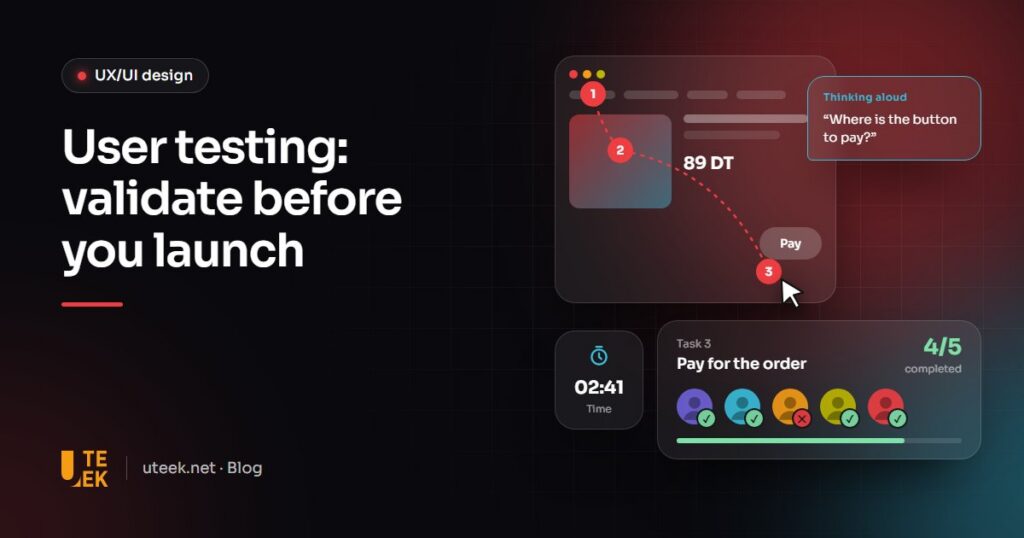
User testing means watching real people carry out real tasks on your website or app, and it is the most reliable way to find what stops them before launch. A participant who resembles your customers is given a goal, such as requesting a quote, and you observe whether they succeed without help. A handful of participants per user profile is enough to reveal most problems.
Key takeaways
- User testing observes what people do, not what they say.
- Test early and often: on prototypes, before and after launch, before a redesign.
- Five participants per profile reveal most problems; run several small rounds.
- A test only pays off if the issues are fixed, then checked.
What is user testing?
User testing, or usability testing, brings together a participant who resembles your customers, a realistic task and an observer who takes notes without stepping in. You do not ask “Do you like this page?”: you watch whether the person completes the journey.
Why internal reviews are not enough
- Your team knows the product too well: it no longer notices the jargon or the detours.
- Opinions clash: the most senior voice often wins.
- Saying is not doing: a customer may call a form “clear” and still fail to complete it.
When should you test a website or app?
- On wireframes or a prototype: fixing things costs the least at this stage.
- Before launch: on staging, across critical journeys (sign-up, checkout, quote request).
- After launch: analytics show where visitors drop off, and a targeted test explains why.
- Before a redesign: testing the current site shows what to keep and gives you a baseline.
How many participants do you need?
In his article on testing with five users, published by Nielsen Norman Group in 2000, Jakob Nielsen estimates that a round of five participants uncovers about 85% of usability problems. With fifteen participants, he therefore recommends three rounds of five, fixing issues in between: each round checks the fixes and reveals deeper problems.
The rule assumes comparable users. For very different profiles (consumers and resellers, for example), plan three to four people per group for two groups, and at least three each beyond that. Reliable statistics require several dozen participants.
Which testing method should you choose?
| Method | When | What it reveals | Effort |
|---|---|---|---|
| Moderated test, in person or remote | Prototype, before launch or redesign | Why users get stuck | Medium to high |
| Unmoderated remote test | Prototype or live site | Task success and duration | Low to medium |
| Guerrilla test | First wireframes | Obvious misunderstandings | Low |
| First-click test | Wireframes, home page, menus | Whether users start in the right direction | Low |
| Card sorting and tree testing | Designing navigation | How users group content | Low to medium |
| A/B test | After launch, with enough traffic | Which version converts better, not why | Medium |
| Analytics and session recordings | After launch, ongoing | Where visitors hesitate and drop off | Low |
How do you run a user test, step by step?
- Set objectives: for example, “Can visitors find the quote form?”.
- Recruit participants who represent your real customers, for each profile.
- Write realistic scenarios without menu labels: “You are looking for a gift under 100 dinars” rather than “Click on Gift ideas”.
- Ask participants to think aloud: they say what they are looking for and what surprises them.
- Observe without helping: if someone gets stuck, ask “What would you do at home?”.
- Log every issue: screen, observed behaviour, number of participants affected.
- Synthesise and rate severity: blocking, major or minor.
- Fix, then test again to check the fixes.
What should you measure?
- Task success rate: the share of participants who complete the task unaided.
- Time on task: to compare two versions.
- Errors: wrong clicks, backtracking, rejected inputs.
- Satisfaction: a standardised questionnaire at the end of the session.
The most widely used, the System Usability Scale (SUS), created by John Brooke in 1986, has ten statements rated on five points, producing a score from 0 to 100. It is not a percentage: according to MeasuringU, which compiled 500 studies, the average is 68. With five participants, treat it as a trend, not a definitive result.
How do you recruit participants?
- Your customers: customer database, newsletter or a banner on the site.
- Recruitment panels: participants selected to match your criteria.
- People outside the project: good enough for a guerrilla test.
- An incentive: a voucher or discount in line with the session length.
Get signed consent covering recordings, retention and the right to withdraw: these are personal data, subject to Tunisian law and, where it applies, the GDPR.
Include people with disabilities too: the W3C explains how to involve users in evaluating accessibility, alongside a WCAG conformance check.
Mistakes that skew a test
- Testing with colleagues: they already know the product and its vocabulary.
- Asking leading questions: “Is this button clear?” suggests the answer.
- Testing too late: a few days before launch, only minor fixes remain possible.
- Planning too many tasks: fatigue skews the last ones.
- Not acting on the findings: a report without a fix plan improves nothing.
FAQ
What is the difference between user testing and acceptance testing?
Acceptance testing checks that the site works as specified: links, forms, payments. User testing checks that real people can actually use it. A site with no defects can still be hard to use.
Can you test an app before it is built?
Yes, and it is the most cost-effective time. A clickable prototype is enough to test navigation, and fixes are made in the mock-up rather than in the code.
How long does a test session last?
Allow 30 to 60 minutes per participant, including the questionnaire. Five sessions therefore fit into one or two days.
Does A/B testing replace user testing?
No, they are complementary. An A/B test shows which version performs better, but not why, and needs a live site with traffic. User testing explains what blocks people, from the wireframe stage onwards.
Test your website or app with Uteek
At Uteek, a digital agency based in Les Berges du Lac 2, Tunis, our UX/UI team runs user tests on prototypes and live products, then builds the fixes in. Explore our UX/UI design services, browse our achievements or tell us about your project.
Related articles
Web accessibility: a practical guide to making your website usable by everyone
Contrast, keyboard navigation, alt text, forms: web accessibility benefits all your visitors and is now a legal requirement…
Design system: why you need one and how to build it
Tokens, components, documentation, governance: what a design system really is, how it differs from a style guide or…
Brand identity redesign: 10 steps from audit to launch
Dated logo, inconsistent materials, new positioning? From audit to trademark filing, here are the 10 steps of a…