


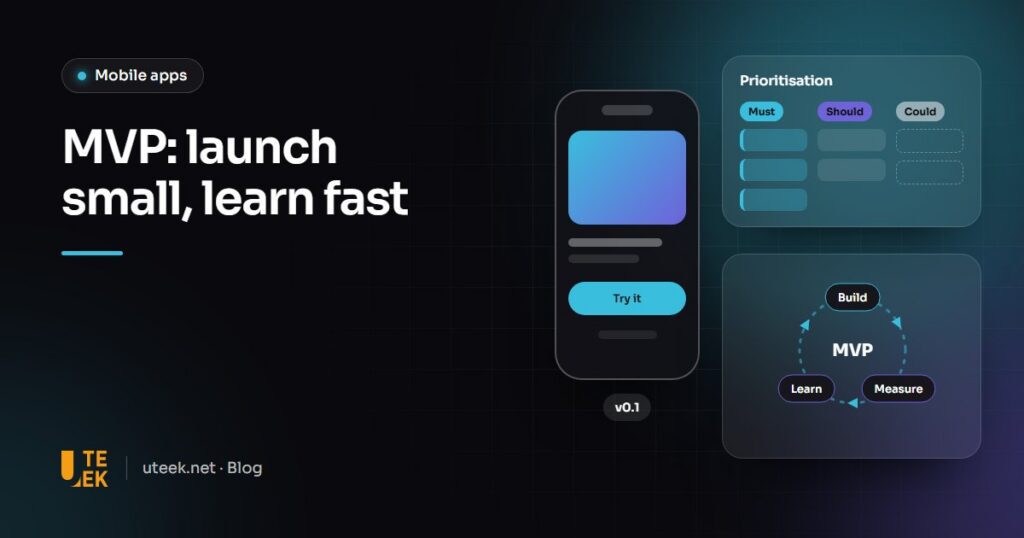
An app MVP (minimum viable product) is the simplest version of your product that lets real users solve a specific problem, and lets you test your assumptions before investing further. The aim is to learn as much as possible with the least effort, not to spend less by delivering less. A well-scoped MVP targets one problem, one user profile and one journey, with metrics set before launch. It is the best protection against the costliest risk: an app nobody uses.
Key takeaways
- An MVP is a learning tool: it tests specific assumptions with real users.
- Simple does not mean sloppy: it must stay reliable and secure.
- Only the features essential to the core journey make the cut.
- Success metrics are set before launch, not after.
What exactly is an MVP?
The concept was popularised by Eric Ries. The Lean Startup principles rest on a build, measure, learn loop: build a first version, measure how users respond, then persevere or pivot. Ries defines the MVP as the version of a new product that allows a team to collect the maximum amount of validated learning about customers with the least effort.
What an MVP is not
- A rushed version: bugs drive users away before they judge the idea.
- A mere prototype: an MVP is used in real conditions.
- A cut-down version 1: its scope starts from the assumptions to test.
Proof of concept, prototype, MVP or version 1: what is the difference?
Each stage answers a different question; with no technical risk, skip the proof of concept.
| Stage | Goal | Audience | What it proves |
|---|---|---|---|
| Proof of concept (POC) | Check technical feasibility | Project team, decision-makers | That the technology works |
| Prototype | Test screens and journeys | User panel | That the interface is understood |
| MVP | Validate the need in real conditions | First targeted users | That people use it and come back |
| Version 1 | Offer a complete, lasting product | Wider target market | That the product can grow |
How do you define the scope of an MVP?
A successful MVP is deliberately narrow:
- One problem: a frequent one your users already try to solve.
- One target user: a precise profile, such as small shop managers.
- One core journey: the shortest path to the result.
- Testable assumptions: “shop managers will log their stock daily if it stops them running out”.
Keep only the Must haves
The MoSCoW method sorts features into Must have, Should have, Could have and Won’t have; an MVP keeps only the first group. A simple test: if the journey still works without a feature, even with a manual workaround, it can wait. The Agile Business Consortium (DSDM framework) recommends not exceeding 60% of the effort on Must haves, to keep a margin.
Steps to define your MVP
- State the user’s problem in one sentence.
- Talk to a few target users.
- List your assumptions, riskiest first.
- Map the core journey.
- Sort its features with MoSCoW.
- Set success metrics and decision thresholds.
- Pick the lightest technical route to measure them.
Which technical approach suits an MVP?
Look for the lightest route to learning, not the ideal technology:
- Cross-platform: one codebase for iOS and Android.
- PWA: enough if you need neither the stores nor advanced device features.
- No-code: for some tests (sign-up, service delivered by hand), at the cost of platform dependence.
- Existing services: for authentication, payments or notifications.
Lightweight does not mean fragile: strong authentication, encryption, minimal data collection and legal compliance apply from the first version. The OWASP MASVS sets out baseline security and privacy requirements for mobile apps. Version-controlled, documented code lets the MVP evolve without a rewrite.
How do you measure whether an MVP works?
Before launch, set your metrics and the threshold for each decision:
- Activation: share of sign-ups completing the key action (first booking, first quote).
- Retention: share returning after a week, then a month.
- Conversion: purchase, subscription or demo request.
- Qualitative feedback: interviews, in-app surveys, support requests.
Set up analytics from day one (one event per step, consent where required) and review figures and user comments regularly.
What drives the budget and timeline of an MVP?
The cost depends on the MVP’s content: journeys and screens, platforms, back office and roles, integrations (payment, ERP, third-party APIs), security requirements, data to prepare and decision speed. The safest approach: fix a budget and a launch date, then adjust the scope.
Which mistakes should you avoid?
- Too many features: the launch slips and the measurement blurs.
- No metrics: every result then looks encouraging.
- Building for everyone: it convinces no one.
- Neglecting quality: crashes drive users away and skew the test.
- Waiting for perfection: every week of delay is a week without learning.
What comes after the MVP?
Three outcomes are possible:
- Persevere: metrics hit their thresholds; iterate in small releases.
- Pivot: the signal shows up elsewhere; change the target, problem or model.
- Stop: no key assumption holds; you avoid a pointless version 1.
If you persevere, version 1 adds the Should haves and pays down technical debt.
FAQ
What is the difference between an MVP and a prototype?
A prototype is a simulation, often a clickable mock-up, that tests whether an interface is understood. An MVP is a working product used by real users: it validates the need.
Is an MVP only for start-ups?
No. An SME launching a service or a large company digitising a process benefits just as much from testing its assumptions before rolling out, for example on a single site.
Should an MVP be published on the App Store and Google Play?
Not necessarily. A PWA, Apple’s TestFlight or Google Play’s testing tracks can reach a chosen group of users. A public release then helps measure acquisition.
Can the MVP code be reused for version 1?
Yes, if it rests on a clean foundation: versioned code, a clear architecture and proper security. No-code or throwaway parts often need rebuilding, so decide this at the scoping stage.
Launch your MVP with Uteek
At Uteek, a digital agency based in Les Berges du Lac 2, Tunis, we help you scope your MVP (requirements documents, prioritisation), design its UX/UI and build it for mobile or the web, on a foundation ready to evolve. Explore our mobile app services, browse our achievements or tell us about your project.
Related articles
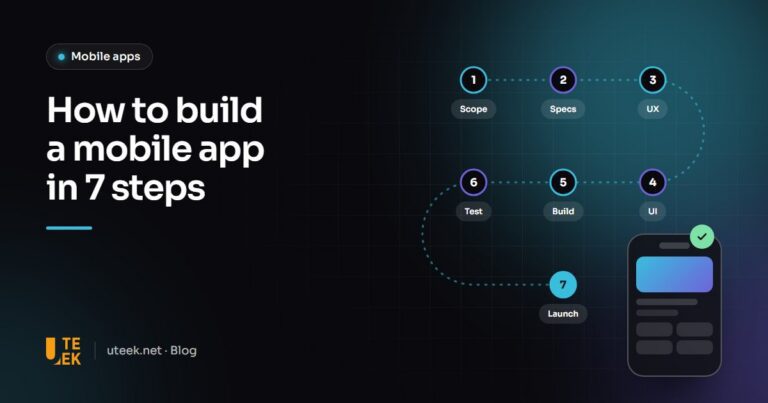
How to build a mobile app in 7 steps, from idea to app store launch
Scoping, UX, UI, development, testing, app store launch… The 7 steps to build a mobile app, with the…
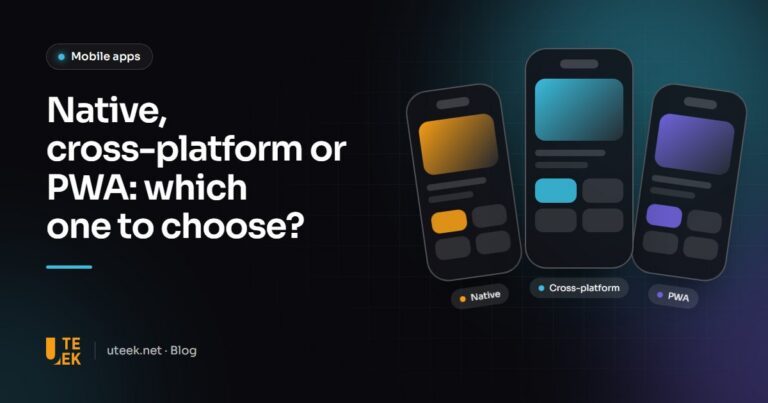
Native, cross-platform or PWA: how to choose your mobile app technology in 2026
Swift and Kotlin, Flutter and React Native, or a simple PWA? A clear comparison of the three approaches…
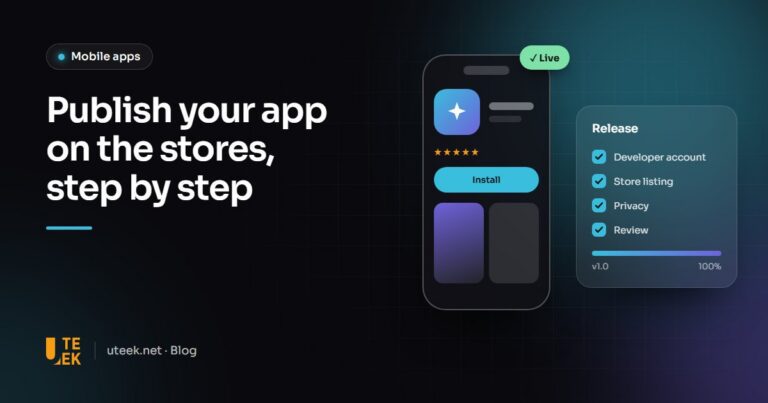
How to publish an app on the App Store and Google Play: a step-by-step guide
Developer accounts, store listing, App Privacy and Data safety, beta testing, review and common rejections: a practical guide…