


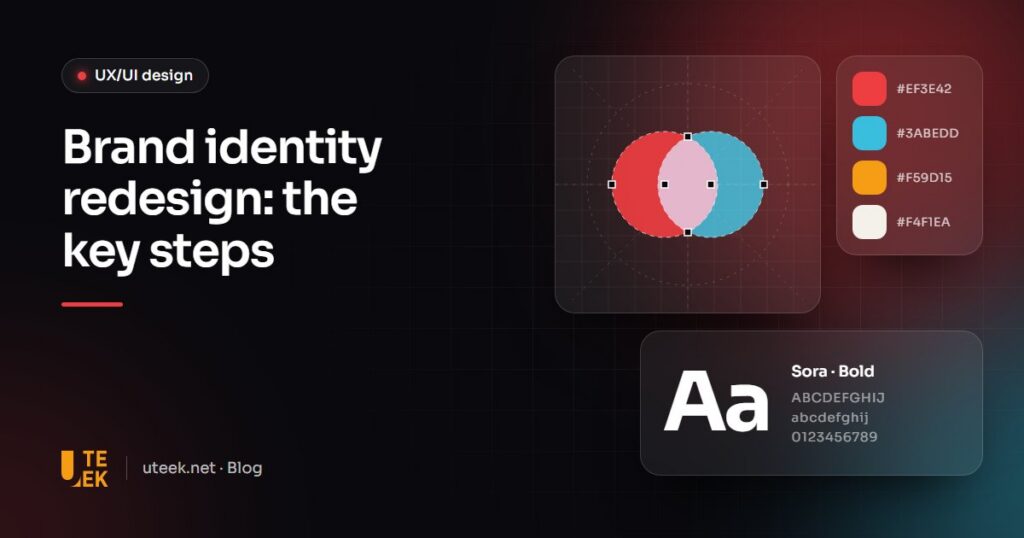
A brand identity redesign means rethinking an organisation’s visual system (logo, colours, typography, imagery, usage rules) so that it reflects its strategy again and works everywhere, from app icon to signage. It starts with an audit and a brand platform, not the logo, and ends with brand guidelines, a roll-out plan and a trademark filing.
Key takeaways
- The brand is a perception; the visual identity is the system that makes it recognisable; the logo is one part of it.
- An evolution modernises without losing recognition; a revolution calls for a profound change.
- The process runs from audit to guidelines, then a planned roll-out across digital and print.
- Check that the mark is available and register it (with INNORPI in Tunisia) before launch.
Brand, visual identity, logo: what is the difference?
These three terms are often confused:
| Brand | Visual identity | Logo | |
|---|---|---|---|
| Definition | The overall perception of your organisation | The graphic system that makes the brand recognisable | The mark that signs the brand |
| Content | Promise, values, tone, reputation | Logo, colours, typefaces, icons, photos, layouts | Symbol and/or wordmark, with its variants |
| Reference document | Brand platform | Brand guidelines | Part of the brand guidelines |
When should you redesign your visual identity?
Warning signs include:
- the logo becomes illegible at small sizes (favicon, app icon, social avatar);
- materials differ between departments or countries;
- the image no longer reflects the business: new offer, repositioning, merger, new markets;
- the identity looks dated next to competitors;
- with no guidelines, everyone reinvents colours and layouts.
Then choose between evolution and revolution. An evolution modernises the logo, palette or typography while keeping recognised elements: the safest option for a well-known brand. A revolution (a new symbol, even a new name) calls for a merger or a deep repositioning.
The 10 steps of a brand identity redesign
1. Audit existing assets and perception
List every touchpoint (website, app, social media, documents, signage, packaging) and interview management, staff and customers: what is recognised, what jars, what must stay.
2. Formalise the brand platform
Positioning, mission, values, audiences, personality and tone of voice: this becomes the objective yardstick for judging proposals, rather than personal taste.
3. Run a benchmark and build a moodboard
Analyse your sector’s visual codes, then gather references (shapes, colours, imagery) to agree on a direction before drawing.
4. Explore creative routes
Present two or three contrasting routes in context (home page, app screen, business card, social post), not on a blank background.
5. Design the logo and its variants
Primary, horizontal, vertical, monochrome and reversed versions, plus the symbol alone. A responsive logo simplifies as the display size shrinks, down to the favicon and app icon, legible even at a few pixels.
6. Build the colour palette
Primary, secondary, neutral and status colours (success, error), with screen (RGB, hex) and print (CMYK, Pantone) values. For contrast, the WCAG guidelines require at least 4.5:1 for body text and 3:1 for large text; logo text is exempt, your website’s text and buttons are not.
7. Choose the typography
One or two families that read well on screen and in print, with the weights you need and, if you communicate in Arabic, a matching Arabic typeface. Check the licence covers web, app and print.
8. Define the graphic elements
Icons, illustrations, patterns, photography style (framing, light, subjects) and animation principles for motion design.
9. Write the brand guidelines
Clear space and minimum logo size, misuses, palette, typography, examples and templates. They also feed the design system: the redesign must stay consistent with your website and app UX/UI, where colours and typefaces become buttons, fields and states.
10. Roll out and launch
Plan the transition: website, social media, email signatures and sales documents first, then signage, vehicles, packaging and printed stock. Announce the change internally before going public.
How do you protect the new identity?
Before approving a name or logo, check for similar earlier trademarks covering the same goods or services, and for available domain names and social handles. In Tunisia, trademarks are filed with INNORPI (National Institute for Standardisation and Industrial Property); registration lasts ten years from filing and is renewable. For export, WIPO’s Madrid System, which Tunisia joined in 2013, covers several countries with one application, while an OAPI filing covers its 17 member states, mostly in West and Central Africa.
Pitfalls to avoid
- Following trends: an identity should last for years.
- Too many decision-makers: a large committee produces a characterless compromise.
- Forgetting digital uses: round avatars, favicons, dark mode, app screens.
- Delivering without guidelines: without written rules, the identity soon erodes.
FAQ
How long does a brand identity redesign take?
A few weeks to evolve a logo and palette; several months for a full redesign with brand platform, guidelines and roll-out. Internal approval rounds often take as long as the creative work.
Should you change your name at the same time?
Rarely: only if the current name raises a legal issue, is misunderstood in new markets or no longer fits the business. It then means far more work: trademark filing, domain name, company formalities, SEO.
Does a redesign affect search rankings?
The visual change alone does not. If the website’s structure or domain also changes, plan 301 redirects. Update the logo in your structured data, Google Business Profile and social profiles to stay consistent for search engines and AI assistants.
Who owns the logo and the source files?
You should. The contract must cover the assignment of copyright in the designs and the delivery of vector source files (SVG, AI, PDF) and font licences in your name.
Redesign your brand identity with Uteek
Uteek, a digital agency at Les Berges du Lac 2 in Tunis, modernises existing identities or creates new ones: logo, brand guidelines, print materials (brochures, reports, roll-ups, business cards, packaging) and digital applications, plus motion design. Our graphic and UX/UI design team keeps it all consistent with your website and apps. Browse our achievements or tell us about your project.
Related articles
Web accessibility: a practical guide to making your website usable by everyone
Contrast, keyboard navigation, alt text, forms: web accessibility benefits all your visitors and is now a legal requirement…
Design system: why you need one and how to build it
Tokens, components, documentation, governance: what a design system really is, how it differs from a style guide or…
User testing: how to validate your website or app before launch
Internal opinions cannot validate a user journey. When to test, how many participants, which methods and what to…