


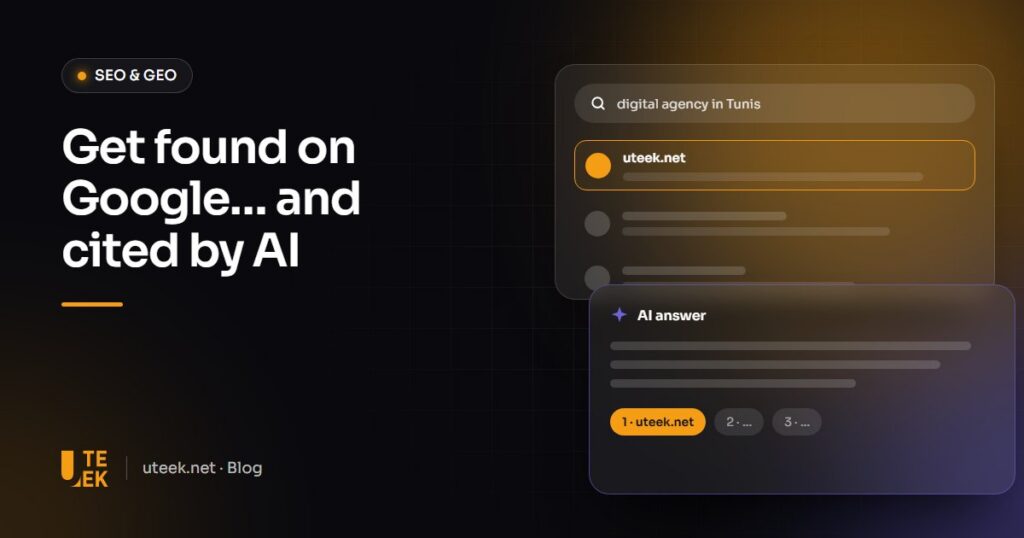
GEO (Generative Engine Optimisation) means optimising a website so that AI-powered answer engines understand it, reuse it and cite it: Google’s AI Overviews and AI Mode, ChatGPT Search, Perplexity, Gemini and Copilot. It does not replace SEO; it builds on it. A site that Google struggles to index has very little chance of being cited by an AI assistant.
Key takeaways
- SEO gets you into search results; GEO gets you quoted in AI-generated answers.
- AI engines favour pages that answer a question directly, with verifiable facts and a clear structure.
- Technical foundations (indexing, speed, structured data, mobile) underpin both disciplines.
- A consistent online identity (name, address, services, reviews) helps AI assistants recommend you.
SEO, AEO, GEO: what is the difference?
Three acronyms are doing the rounds, and they describe three levels of the same goal: being the best possible answer to a user’s question.
| Discipline | Goal | Where you appear | Main metric |
|---|---|---|---|
| SEO (Search Engine Optimisation) | Rank well in search results | Google and Bing results pages | Rankings, clicks, organic traffic |
| AEO (Answer Engine Optimisation) | Provide the direct answer | Featured snippets, voice search | Position-zero visibility |
| GEO (Generative Engine Optimisation) | Be cited or recommended by AI | AI Overviews, ChatGPT, Perplexity, Gemini | Brand mentions and citations |
Why GEO now matters
People no longer type only keywords: they ask an assistant full questions such as “which agency should I hire to build a mobile app in North Africa?”. The AI then summarises several sources and cites only a handful of them.
As a result, a growing share of searches ends without a click, and the brands named in the answer capture attention and trust. For B2B companies targeting Europe, Africa or the Middle East, this is also an opportunity: on specialist queries, competition is still limited and expert content can quickly become a reference source.
The SEO foundations GEO depends on
Before writing content for AI, make sure your website is technically sound:
- Indexing: an up-to-date XML sitemap, a robots.txt file that doesn’t block important pages, and no key page set to “noindex”.
- Performance: aim for Google’s Core Web Vitals thresholds, namely an LCP of 2.5 s or less, an INP of 200 ms or less and a CLS of 0.1 or less.
- Mobile: Google primarily indexes the mobile version of your site.
- Multilingual: on an English / French website, hreflang tags tell search engines which version to show to which audience.
- Internal linking: every important page should be reachable in a few clicks and linked to related content.
7 practical actions to get cited by AI engines
1. Answer first, then expand
Put a clear two- or three-sentence answer right after each heading, then go into detail. This is the format AI systems extract most easily, and the one busy readers appreciate.
2. Structure pages around real questions
Write subheadings the way your customers phrase their questions. Lists, numbered steps and comparison tables are especially likely to be reused in generated answers.
3. Provide verifiable facts
Dated figures, project examples, detailed methods and a named author: AI engines favour precise, attributable content. Avoid generic statements found on hundreds of other websites.
4. Add structured data
Schema.org markup (Organization, LocalBusiness, Article, FAQPage, BreadcrumbList) explicitly describes who you are and what each page contains. A plugin such as Yoast SEO generates much of it automatically.
5. Keep your entity consistent
Name, address, phone number and service descriptions should be identical on your website, your Google Business Profile, LinkedIn and business directories. Public customer reviews also strengthen your credibility with AI systems.
6. Let AI crawlers access your content
Check that your robots.txt does not block the search crawlers used by assistants, such as OAI-SearchBot for ChatGPT or PerplexityBot. You can also publish an llms.txt file summarising your key pages; some SEO plugins, including Yoast, can generate it automatically.
7. Update regularly
A visible “last updated” date and genuinely refreshed content are freshness signals for Google and answer engines alike.
How to measure your visibility in AI answers
GEO tracking is still imperfect, but several indicators are already usable:
- Google Search Console: impressions and clicks from Google’s AI features are included in the Performance report.
- Google Analytics 4: track referral traffic from chatgpt.com, perplexity.ai, gemini.google.com and copilot.microsoft.com.
- Question panel: every month, ask the main assistants the ten questions your customers ask and note whether your brand is cited.
- Brand mentions: monitor the articles, directories and forums that mention you; they are often the sources AI engines rely on.
SEO + GEO checklist
| Action | SEO impact | GEO impact |
|---|---|---|
| Sitemap and indexing under control | High | High |
| Core Web Vitals in the green | High | Medium |
| Direct answer under each heading | Medium | High |
| Tables, lists and FAQs | Medium | High |
| Schema.org structured data | Medium | High |
| Consistent business information everywhere | Medium | High |
| AI crawler access allowed | Low | High |
| Updated, dated content | Medium | High |
FAQ
Does GEO replace SEO?
No. AI engines largely rely on pages that are already well indexed and considered trustworthy by search engines. GEO adds an editorial and semantic layer on top of solid SEO.
How long does it take to see results?
With SEO, the effects of in-depth work usually show after a few months. With GEO, it depends on how often engines recrawl your pages: well-structured content can start being cited a few weeks after it is indexed.
Should I block AI crawlers?
It is a strategic choice. Blocking training crawlers (such as GPTBot or Google-Extended) does not necessarily stop you appearing in answers, but blocking search crawlers (such as OAI-SearchBot) makes you invisible in those assistants. For a business looking for customers, we recommend allowing search crawlers.
Is an llms.txt file mandatory?
No. It is a proposed standard that emerged in 2024, and its use by search and answer engines is not guaranteed. It costs almost nothing to set up, but it replaces neither good content nor good SEO.
Take action
At Uteek, a digital agency based in Lac 2, Tunis, we build SEO and GEO into every website from day one: architecture, performance, structured data and content designed to be cited. Would you like an audit of your visibility on Google and in AI answers? Let’s talk about your project.
Related articles
Website redesign: the SEO checklist to keep your traffic
A poorly prepared redesign can wipe out years of search visibility. Inventory, 301 redirects, testing and monitoring: the…

Launching an e-commerce website in Tunisia: platform, online payments, delivery and compliance
Cash on delivery or online payment, logistics, legal requirements, platform choice: everything to plan when launching an e-commerce…

UX/UI design: 8 mistakes that drive users away (and how to fix them)
Confusing navigation, endless forms, tiny buttons… These 8 UX/UI mistakes cost businesses customers every day. Here is how…