


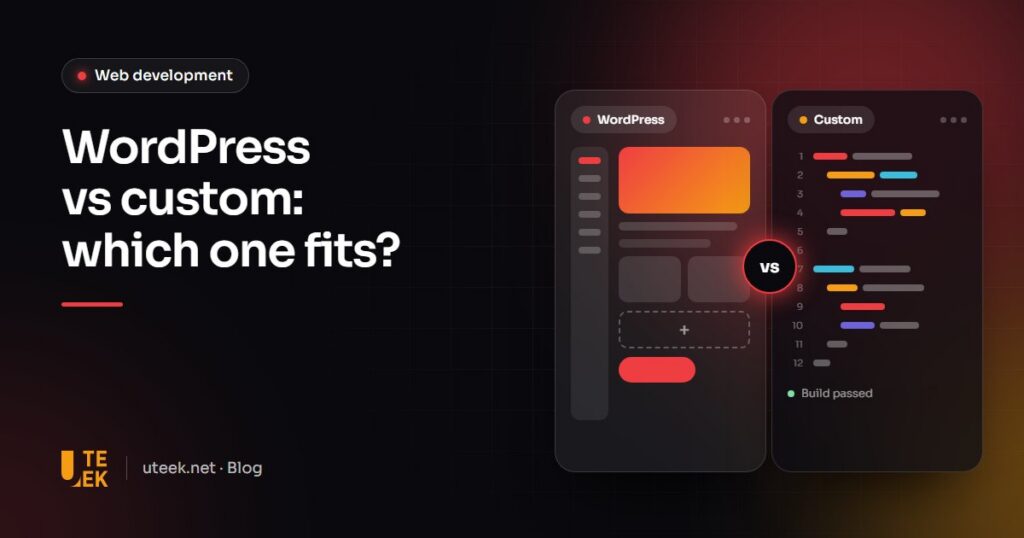
WordPress vs custom development: the right answer depends on your project more than on the technology, namely what the site has to do, who will update it and how it needs to evolve. WordPress is usually the right choice for a corporate website, a blog or a standard online shop that your team wants to run on its own. Custom development makes sense when the core of the project is specific business logic.
Key takeaways
- WordPress suits most corporate websites, blogs and standard online shops, and gives your team real editorial autonomy.
- Custom development (Laravel, Symfony, Next.js…) is the better fit when business logic or integrations go beyond what a CMS handles well.
- The real cost plays out over several years: maintenance, security and new features matter as much as the launch.
- Either way, insist on code ownership, documentation and admin access in your own name.
What is the difference between WordPress and custom development?
WordPress is an open-source CMS (content management system): a ready-made foundation that you adapt with a theme and plugins. According to W3Techs, it powers close to 40% of all websites, and around six in ten of the sites whose CMS can be identified.
Custom development starts from a framework (Laravel or Symfony in PHP, Next.js in JavaScript…) and builds only what the project needs: data model, business rules, interfaces and back office.
WordPress: strengths and limits
What WordPress does well
- Autonomy: the block editor lets your team publish without a developer.
- Ecosystem: tens of thousands of plugins cover SEO, forms, e-commerce (WooCommerce) and bookings.
- Speed and entry cost: the foundation already exists; for a standard scope, the initial budget is usually lower.
Where WordPress reaches its limits
- Plugin sprawl: each plugin adds code to maintain and a risk of conflicts or vulnerabilities.
- Maintenance discipline: core, theme and plugins need regular updates, as the official guide to hardening WordPress points out.
- Performance: heavy page builders bloat the code and drag down Core Web Vitals.
- Complex business logic: workflows, fine-grained permissions or ERP synchronisation end up bending the CMS out of shape.
Custom development: strengths and limits
What custom development brings
- Exact fit: the data model and user journeys follow your processes, with no superfluous code.
- Integrations: ERP, CRM, payment or internal systems are designed into the architecture from day one.
- Scalability: the application grows with your business without depending on a third-party plugin.
What you have to accept
- Cost and timelines: everything is designed and tested specifically, so it takes more time and budget upfront.
- A back office to build: there is no admin interface by default, so it must be in the specification.
- Dependence on the team: without code ownership, documentation and automated tests, switching providers becomes difficult.
Is headless a middle ground?
In a headless architecture, WordPress only manages content, served through its REST API, while the front end is built separately, for example with Next.js. Your team keeps a familiar back office and the site gains the freedom of custom development. In return, you maintain two applications, and plugins that affect the front end no longer work as they are. It is best suited to high-traffic or multichannel websites.
Which option for which type of project?
| Type of project | Usually the right option | Why |
|---|---|---|
| Corporate website | WordPress | Autonomy, fast launch, controlled budget |
| Blog or media site | WordPress, or headless for high traffic | Proven editor, author management |
| Standard online shop | WordPress with WooCommerce | Catalogue, basket, payment and delivery covered |
| Multi-vendor marketplace | Custom | Vendor accounts and commissions are hard to manage with plugins |
| Business platform or client portal | Custom | Permissions, workflows and integrations are central |
| Multilingual website | WordPress with a plugin (WPML, Polylang), or custom | Depends on content volume and the translation process |
What does each option really cost?
The development quote does not tell the whole story: the total cost of ownership also includes hosting, premium plugins, updates, security, backups and new features. A WordPress site overloaded with plugins is expensive to maintain; a poorly documented custom application is expensive to evolve. Either way, plan for a maintenance contract and an annual budget for improvements.
5 questions to help you decide
- Who will update the content, and how often?
- Are your needs standard: pages, blog, forms, shop?
- Does the project rely on specific business rules, user roles or integrations?
- What annual budget can you set aside for maintenance?
- How should the tool evolve over the next three years?
Mostly about publishing content? Choose WordPress. Mostly a working tool at the heart of your business? Go custom.
FAQ
Is WordPress secure enough for a professional website?
Yes, if it is properly maintained. Most incidents come from outdated plugins, weak passwords or poorly configured hosting. Keep plugins to a minimum and automate updates and backups.
Is a custom website always faster?
Not necessarily. A lean WordPress site without a heavy page builder can also achieve good Core Web Vitals. The quality of the build matters more than the technology.
Can you move from WordPress to custom development later?
Yes. Content can be exported or served through the REST API, which allows a gradual migration, for example via a headless set-up. Plan your redirects to protect your search rankings.
Who owns the code of a custom development?
It depends on the contract. Ask for the rights to the custom code, repository access, documentation and admin access in your own name, so you remain free to change provider.
Choose the right approach with Uteek
At Uteek, a digital agency based in Les Berges du Lac 2, Tunis, we build easy-to-manage WordPress websites and custom applications with modern frameworks, and we can help you scope your project (client-side project support, requirements documents). Explore our web development services, browse our achievements or tell us about your project.
Related articles
WordPress security: the essential measures to protect your website
Most WordPress vulnerabilities sit in plugins, not in the core. Updates, accounts, backups, hosting: the measures to prioritise…
Personal data on your website: complying with Tunisian law and the GDPR
Law 2004-63, INPDP filings, the GDPR for European customers, cookie banners, security and service providers: what a Tunisian…
Launching an e-commerce website in Tunisia: platform, online payments, delivery and compliance
Cash on delivery or online payment, logistics, legal requirements, platform choice: everything to plan when launching an e-commerce…